
Protest Leader Admits: 'We Failed to Topple the Government' — So What Were They Actually Fighting For?
A 'transparency' activist turned party candidate exposes the core contradiction of Israel's protest movement
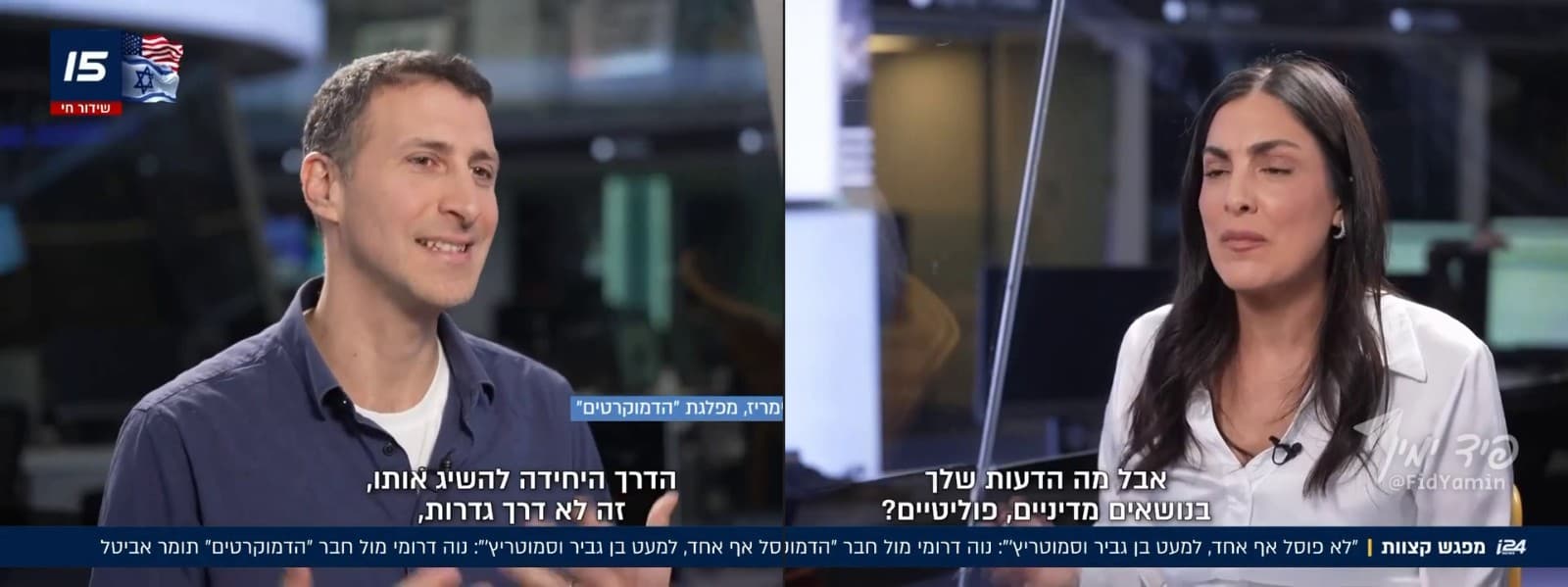
In an interview on "Cabinet Friday" with Naveh Dromi on Channel 15 (i24NEWS), Tomer Avital said something the Israeli right has known for three years but the left refused to admit: "We failed. We couldn't bring down the government after October 7." This admission, delivered almost casually, is the most honest moment to emerge from Israel's protest movement since its inception.
Until now, the messaging was entirely different. "We're fighting for democracy," "We're protecting the rule of law," "We're not left or right — we're citizens." Avital himself built an entire career on this image: founder of "Shakuf" (Transparent), an organization claiming to represent public transparency, and founder of "Lobby 99," which presents itself as a non-partisan civic body. And now? He's a Knesset candidate on Yair Golan's Democrats party list.
## From 'Civic Activism' to Party Politics
Avital's transition from "independent journalist" and "transparency activist" to party candidate is the most natural move possible — because he was always partisan. His "transparency" always pointed in one direction, his "lobby" always pushed one agenda. Now he's simply stopped pretending.
But what's truly revealing is the double standard exposed in the interview. Avital supports peace — but isn't clear with whom. He opposes boycotts — except when it comes to Ben-Gvir and Smotrich. He believes in freedom of expression — but wants to shut down Channel 14. He fights "for democracy" — but admits the goal was to topple a democratically elected government.
## The Contradiction That Reveals Everything
"The Kaplan protest wasn't violent," Avital said in the interview. But beyond the factual accuracy of that claim, the real question is different: what was the Kaplan protest trying to achieve? Avital himself provided the answer — regime change. Not constitutional reform, not institutional improvement, not strengthening democracy. Toppling an elected government.
And when that failed, what's the next move? Join a political party. And not just any party, but one that absorbed all the protest leaders — Moshe Redman, Danny Algert, Moran Michel, and others. The "civic" protest has officially become a candidate list.
## Avital's Democracy — Only When It Serves Him
This is the central contradiction that Avital embodies: democracy is a value only when the outcome suits you. When the right wins elections — you need to "topple the government." When a media channel doesn't align — you need to "shut it down." When right-wing politicians exercise their authority — they're "not partners."
Avital's admission on Cabinet Friday is a rare moment of honesty from someone who built his career on the image of neutrality. Now that the mask has dropped, one question remains: how many of the citizens who supported the "protest for democracy" understood they were supporting an attempted political overthrow?
Join Torenu's newsletter
One sharp email a week. Clear analysis. No noise.
Related posts

Tel Aviv University Removes Student From Dorms Over a 'Return of Refugees' Sticker
Tel Aviv University removed a student from its dormitories over a sticker backing the return of Palestinian refugees, Haaretz reports. The case tests whether campus rules are applied evenly, and what the slogan actually demands.

Hadar Muchtar: The Generation That Doesn't Ask Permission
She was barely out of her teens when she founded one of Israel's most visible right-wing street movements. Today, Hadar Muchtar represents everything the old establishment fears: a young, media-savvy, unapologetic right that refuses to play by the left's rules.

Restoring balance to the public conversation without losing sharpness
Public debate in Israel has become fast, compressed, and often one-sided. Fixing that does not require more noise. It requires a clear method built on framing, responsibility, and governance.